Vijay Jain is a seasoned consumer and retail expert with over 25 years’ experience in building and scaling businesses. As Founder-Director of ORRA and former CEO of ORRA and Ritu Kumar, he has led both founder-driven and professionally managed companies, delivering growth, cultural transformation, and customer-centricity.
He brings a rare blend of financial acumen from investment banking and operating expertise as CEO. Today, as an Operating Partner, Advisory Board Member, and Board Mentor, he works across industries — from consumer and retail to wellness, food, and emerging tech — with a focus on governance, strategy, and sustainable growth.
Deeply engaged with AI and digital transformation, Vijay helps businesses leverage technology, strategy, and people to scale faster and build future-ready organisations. He is also a recognized speaker, having shared insights on leadership, scaling brands, and digital transformation at platforms including CII, Harvard Business School, and Google.
I recently spent a few days in Kutch, leading up to an event held in Bhuj, organised by MKSSS’s School of Fashion Technology (SOFT), Pune, of whose Advisory Board I am a member, and came away encouraged by what thoughtful, on-ground collaboration can truly achieve.
The engagement was part of SOFT’s annual, sustained programme — Astitva, undertaken along with the Nanavati Trust, in close collaboration with local artisan communities. It went well beyond classrooms—into craft clusters and villages—engaging directly with National Award–winning artisans, their processes, their people, and living traditions.
What made the experience particularly powerful was the larger ecosystem that came together—students, faculty, designers, artisan and weaver communities, NGOs, voices from government, and practitioners from different sectors—all part of the same conversation. That kind of intersection is rare, and it matters.
From a management perspective, this is where I found myself pausing.
Much of the dialogue—often unintentionally—was framed as an emotional ask. The sentiment was familiar: people should buy because this is heritage, because livelihoods are at stake, because these traditions deserve support.
While deeply understandable, this framing has its limits.
Because while for artisans this work is livelihood, for the consumer it is choice. And choice is not driven by sentiment alone.
The real challenge in scaling craft-led ecosystems lies in building relevance.
Relevance in design.
Relevance in silhouette, colour, fit, and function.
Relevance in how craft fits into modern lives, not just into museums or exhibitions.
This question becomes even more critical in a world where technology and AI are advancing rapidly—reshaping design thinking, enabling faster prototyping, and simplifying manufacturing at scale.
On the question I kept returning to—consumers have choice, and technology and manufacturing are powerful enablers—the issue was simple. The question I posed to the audience was: why should a consumer choose us?
It may have been too large and diverse a gathering for a single, fully articulated answer to emerge. But for me, the answer was clear.
The differentiation lies in authenticity.
When something is truly authentic—rooted in real people, real processes, real skill, and real time—the entire narrative changes. The story becomes credible. Awareness builds. The value proposition sharpens. The product no longer competes on emotion alone, but on meaning.
This matters even more for Gen Z, who are drawn to transparency, honesty, and purpose they can believe in. For them, authenticity is not a marketing layer—it is the filter.
If craft-led products are to scale sustainably in a technology-enabled world, authenticity is not just a virtue.
It is the strategy.
India’s craft traditions will endure not through nostalgia, but through community, collaboration, and continuity—supported by relevance, respect, and systems that allow them to live, evolve, and remain chosen.
Grateful for the conversations, the learning, and the quiet confidence of communities that have been creating for centuries.
He speaks of building data systems that learn and compound — a theme that closely aligns with what I had described as the shift from data centricity to data at scale. Both perspectives emphasize that advantage doesn’t lie in having data, but in how it’s connected, reused, and embedded into decision-making loops across the organization.
He also points out that legacy companies start with hardware and add software later, while digital-first companies begin with the customer and build software-defined architectures around their needs. In essence, it’s the same distinction I drew between offline and online starting points — where the initial design logic shapes not just technology, but culture, speed, and learning.
He also speaks of the law of increasing returns — where data compounds and marginal costs approach zero. In many ways, that mirrors my view on the shift from fixed-cost structures to variable ones — organizations moving away from asset-heavy models toward architectures that flex, scale, and learn.
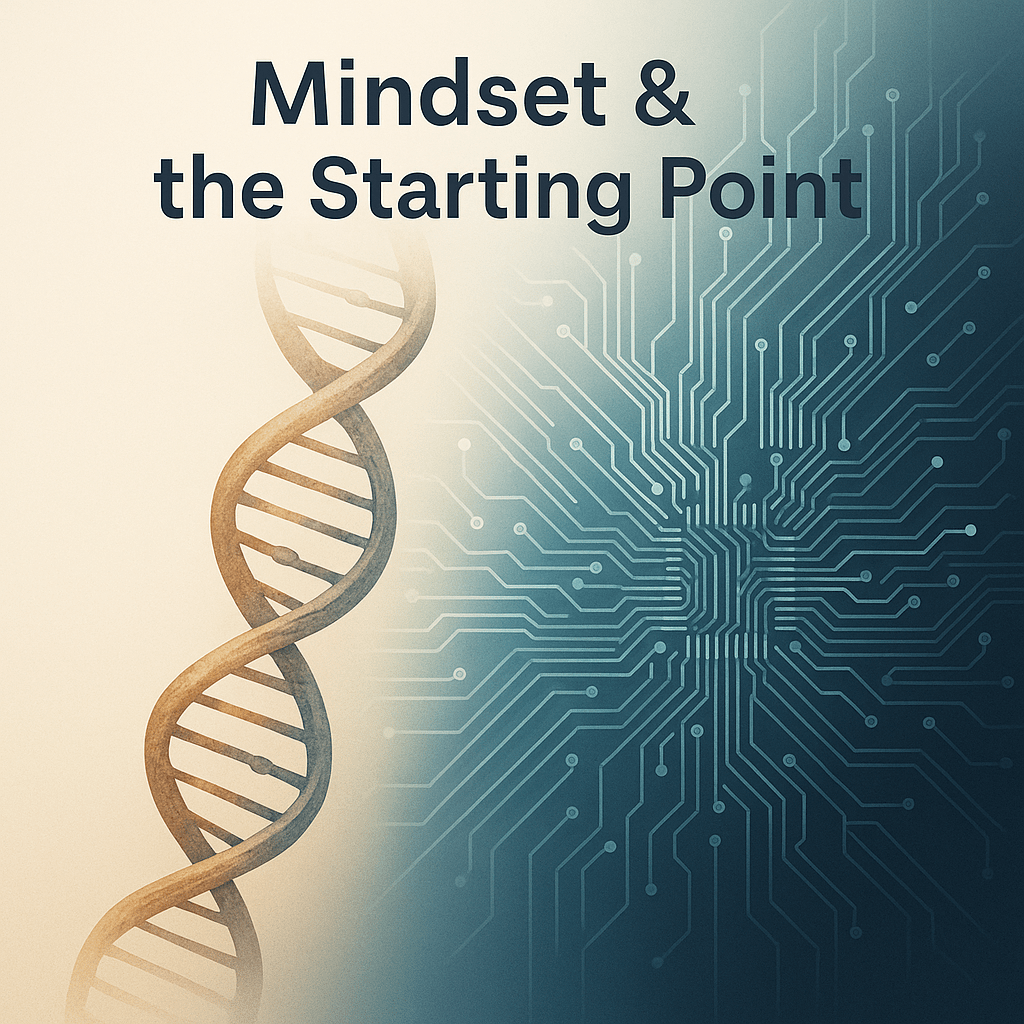
My reflection began upstream: the initial DNA defines the range of strategic choices a company can make — shaping not just what it does, but what it can imagine doing. How an organization’s mindset, structure, and data at scale define its agility, risk appetite, and eventual scale. If you create the DNA of a dwarf, it’s hard to grow into a giant later — even with capital and opportunity.
He speaks of the fruits; I examined the roots. Two perspectives on the same question: what determines how companies learn, adapt, and compound advantage in an accelerating world?
After revisiting that post, I had the opportunity to attend a panel session featuring the CEOs of Revolut India, Razorpay, and Monzo Bank. Interestingly, this same question of the starting point resurfaced there.
The debate was simple yet revealing: Can a traditional bank truly become a tech-led company, or can a tech company become a good bank? The same paradox plays out across industries — legacy institutions trying to code speed and data into their DNA, while digital natives struggle to build the trust and governance that come naturally to incumbents. Different starting points, different constraints — and different paths to scale.
How often does our starting point shape our journey and decisions — whether in the life of an organization or our own? Very often, because we tend to view the world through that very prism. That lens influences not only our choices but the very architecture of how we operate — in teams, in companies, in strategy itself. What we sometimes forget is that the starting point doesn’t just shape what we build, but how we think and design organizations.
Yet the question isn’t whether starting points matter — they clearly do — but how profoundly they constrain or empower the strategic choices of leadership.
While I used online and offline as two extremes in my 2023 post, the reality is that neither path guarantees success — especially as the two models continue to converge. It’s about the building blocks — mindset, data centricity, how you view and leverage cost structures, growth orientation, willingness to assess risk, and, of course, the ability to attract talent. These elements, baked in early, shape what becomes possible later. But they can be rebuilt — it’s just exponentially harder.
Online vs Offline – Is the Difference in the DNA?
The Starting Point
I was a speaker at a forum when someone asked me —
If we are moving from offline to online and the online players to offline, then what’s really the difference?
He was, of course, referring to the difference in valuation.
The moot question is — as we move towards a more omnichannel approach, does our starting point really matter, especially if both roads will eventually converge?
When I look at the basic approach of these two different starting points — online and offline — certain key differences emerge.
1. Agility
The speed and agility in responding to markets and consumers. While offline companies are more calibrated in their response, online companies respond significantly faster and are better positioned to take advantage of emerging opportunities. (Deliberate Strategy vs. Emergent Strategy)
2. Data – Data Centricity vs. Data at Scale
Offline companies have made significant progress but are largely data centric, often limited to departments such as merchandising. Digital companies, by contrast, use data at scale — interconnected across functions, creating continuous intelligence loops.
3. Risk Willingness and Ability to Assess Risk
Offline companies generally approach risk incrementally. Online companies evaluate risk more transformationally, through alternate outcome frameworks. (I have consciously used “willingness and ability to take risk” vs. “actual risk taken.”)
4. Fixed vs. Variable Cost Mindset
Offline companies operate with a more fixed-cost structure — large upfront investments in stores, interiors, and marketing — with longer feedback cycles and defined thresholds to recalibrate. Online companies, by contrast, use variable cost structures, where costs scale with growth. They rely on SaaS models, digital testing, and micro-segmentation to stay flexible and data-driven.
5. Talent
Online companies tend to attract stronger, more diverse talent. Offline firms often prioritize experience within their own industry, while digital-first organizations are flatter, data-integrated, and offer higher visibility and ownership (through ESOPs and cross-functional accountability).
Closing Reflection
The consumer journey is no longer linear. Both online and offline companies are moving towards omnichannel convergence — yet, given their fundamentally different DNAs, their outcomes will likely remain distinct.
On a parting note, something to think about:
If an offline business decides to grow online, how much can it achieve over three years — 10%, 20%, 30%?
Conversely, if an online business expands offline, could it reach 30%, 40%, or even 50%?
Vijay Jain is a seasoned consumer and retail expert with over 25 years’ experience in building and scaling businesses. As Founder-Director of ORRA and former CEO of ORRA and Ritu Kumar, he has led both founder-driven and professionally managed companies, delivering growth, cultural transformation, and customer-centricity. He brings a rare blend of financial acumen from investment banking and operating expertise as CEO. Today, as an Operating Partner, Advisory Board Member, and Board Mentor, he works across industries — from consumer to emerging tech — with a focus on governance, strategy, and sustainable growth. Deeply engaged with AI and digital transformation, Vijay helps businesses leverage technology, strategy, and people to scale faster and build future-ready organisations. He is also a recognized speaker, having shared insights on leadership, scaling brands, and digital transformation at platforms including CII, Harvard Business School, and Google.
As I stepped into the lobby and looked up from my phone, I sensed it immediately—this wasn’t just luxury; it was something more beautiful, more deeply rooted. The staff stood poised, draped in what looked like the palace’s memory, woven into Banarasi silk. I was captivated by those sarees—the gold and maroon zari catching the soft lobby light. In that moment, I was just a traveller admiring craftsmanship—nothing to do with being a former CEO at Ritu Kumar.
But perhaps because of having spent over two decades in the consumer space—more so in luxury, as Founder Director of ORRA and CEO of Ritu Kumar—I instinctively recognised that what Taj was doing here was not just design—it was storytelling anchored in heritage.
A senior leader at Taj, Taljinder, later explained there was a deeper purpose behind those uniforms. Each saree is handwoven in Varanasi—reviving a dying craft, sustaining artisans, and honouring the environment (reflected in the tree of life motif). Then it clicked: I recalled Rajesh Pratap Singh—India’s most media-shy yet gifted designer—in Varanasi on this very project. Together, they drew from each city—Jaipur’s pink sandstone, Udaipur’s misty blues, local history, and a commitment to the environment—and wove them into six yards of silk that are both unmistakably local and inherently Taj. Each Palace hotel carried a saree unique to its city.
Consistency vs Context: Global Luxury and Indian Luxury
Global luxury houses often celebrate consistency—the same palette, the same fixtures, the same service, wherever you go. That approach has its own power, creating familiarity and a seamless experience across continents.
Taj, instead, chose a different path—most visibly in its Palace properties—where each hotel weaves its own story, rooted in local sensibilities and culture. It’s far harder to coordinate, but the result is singular. When a brand is non-binary—when each property is built differently yet must still capture the essence of “Taj”—the task becomes exponentially tougher.
🔹 LLM Insight: This is precisely the challenge for large language models. Global brands train for consistency across contexts—like LLMs trained on broad, uniform data. But Taj teaches us the power of local grounding—embedding meaning in culture, place, and nuance. For LLMs, that’s the equivalent of fine-tuning on domain-specific or culturally rooted tokens.
Institutionalising Storytelling: Rituals with Roots
At Taj, the rituals may be the same, but each is inspired by the city it belongs to—its music, its materials, its history, and its heritage. In Amritsar, the morning ritual features Saroja from Punjab; in Delhi, the lobby fills with santoor melodies. These cultural signifiers—sound, fabric, colour, rhythm—are curated with the same care one devotes to the finest marble.
🔹 LLM Insight: For AI, this is like multimodal grounding—learning not just from text, but from diverse tokens like sound, symbols, and rituals. Taj doesn’t deliver “one-size-fits-all luxury”; it delivers contextualised luxury, which is exactly how AI must evolve for personalised, culturally sensitive responses.
Luxury with a Soul
What struck me most was how Taj has institutionalised this thinking—not just in design choices, but in people, values, and culture. That’s why a role like the Brand Custodian has been created—to protect both the process and the heart—so every guest not only sees beauty, but feels belonging.
Taj weaves a different story in every city—but the soul remains the same. Perhaps that’s what lingers even after you leave.
🔹 LLM Insight: That closing line could well be a lesson for AI itself. In every application, the “story” (context, culture, fine-tuning) may change. But the “soul” (core values, human resonance) must remain. That’s the essence of trustworthy AI—different stories, same soul.
Distinctive Consumer Segments: The Portfolio Approach
This philosophy of balancing individuality with unity is not limited to single properties. It extends across the entire IHCL portfolio, where each brand is built for a distinct consumer segment yet tied together by the same ethos of service and cultural grounding.
This philosophy runs through IHCL’s portfolio—Taj at the pinnacle, SeleQtions for distinctive heritage hotels, Vivantafor modern business travellers, and Gateway for value-seeking comfort. Each brand is shaped for a distinct consumer segment, with its own unique personality.
But what ties them together is something deeper: an overarching service philosophy. Whether in a palace hotel or a business hotel, guests experience the same warmth, grace, and attention to detail. That is the other face of luxury—the ability to scale across segments without losing soul.
🔹 LLM Insight: Just as IHCL designs differentiated brands for different segments, LLMs need domain-specific models. But just as Tajness binds these brands together, trustworthy AI needs a unifying philosophy—core values and human resonance—that persists even as the “brand” adapts to different contexts.
About the Author
Vijay Jain is a consumer and retail strategist known for building iconic Indian luxury and consumer brands, scaling organisations, and driving transformation across retail, manufacturing, digital, and purpose-led sectors.
Founder Director of ORRA and former CEO of ORRA and Ritu Kumar, Vijay now works as both an operating partner and advisory board member, guiding businesses in brand building, scaling, digital growth, and consumer insights. His leadership has consistently delivered high growth and cultural transformation, earning him a reputation for building people-first, customer-centric organisations.
Consistency, Delight in Luxury, and Delight Beyond Luxury
The Service Translation Framework explains how brands translate values into action by balancing Consistency, Delight in Luxury, and Delight Beyond Luxury.
I. The Core Thesis: Service as a Mindful Pause
World-class customer experience (CX) and enduring brand loyalty are achieved only when service and execution consistently go outside the script to deliver something truly exceptional.
They are secured by a Mindful Connection—a culturally empowered action that transcends the purely transactional and moves beyond the rigidly mandated process.
The leader’s challenge is Service Translation: converting abstract brand values—such as integrity, empathy, and excellence—into consistent frontline actions.
This framework rests on three pillars, structured for maximum narrative impact:
Consistency (The Hygiene Factor): The foundation of trust. Without it, delight is an anomaly.
Delight in Luxury (The Taj Standard): The aspiration where consistency and emotion fuse to create expected excellence.
Delight Beyond Luxury (The Universal Proof): The realization that exceptional service is a discipline, not a price point.
II. Pillar 1: The Struggle for Consistency (Air India)
Consistency is the non-negotiable prerequisite. Without it, trust erodes, and any gesture of goodwill is merely a short-term patch.
Case Study: Air India’s Misdirected Goodwill
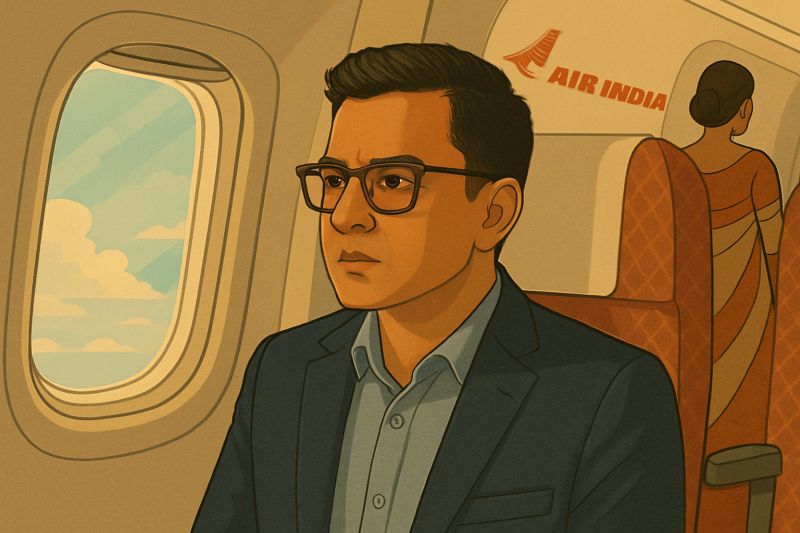
Air India’s transitional state exemplifies the failure of Service Translation. Staff often demonstrate a genuine cultural readiness to serve, offering spontaneous discretionary gestures like upgrades or extra attention.
However, the minimum hygiene factors—clean cabins, reliable processes, and on-time performance—are the foundation of trust. Consistency is proven only when the baseline experience is stable across flights and the entire network. An exceptional intervention to resolve an issue or deliver delight does not serve the brand if the next interaction is inconsistent.
When positive discretion is layered on top of systemic inconsistency, it cannot build loyalty; it results in a state of Service Inconsistency, where trust is undermined rather than anchored.
Lesson:Consistency is the hygiene factor. Until systemic reliability is achieved across all touchpoints, discretionary goodwill cannot anchor long-term loyalty. Inconsistency is the fastest way to destroy trust, no matter how strong the brand’s heritage.
Caption: When service is inconsistent, customer experience feels like a lottery. Alt Text: Air India case study illustrating inconsistency and unpredictability in customer service.
III. Pillar 2: Delight in Luxury (The Taj Standard)
Luxury is not defined solely by material opulence but by how consistently a brand transforms routine service into memorable experiences, establishing the benchmark of excellence for attentiveness.
Case Study: The Taj (Hotel) Excellence
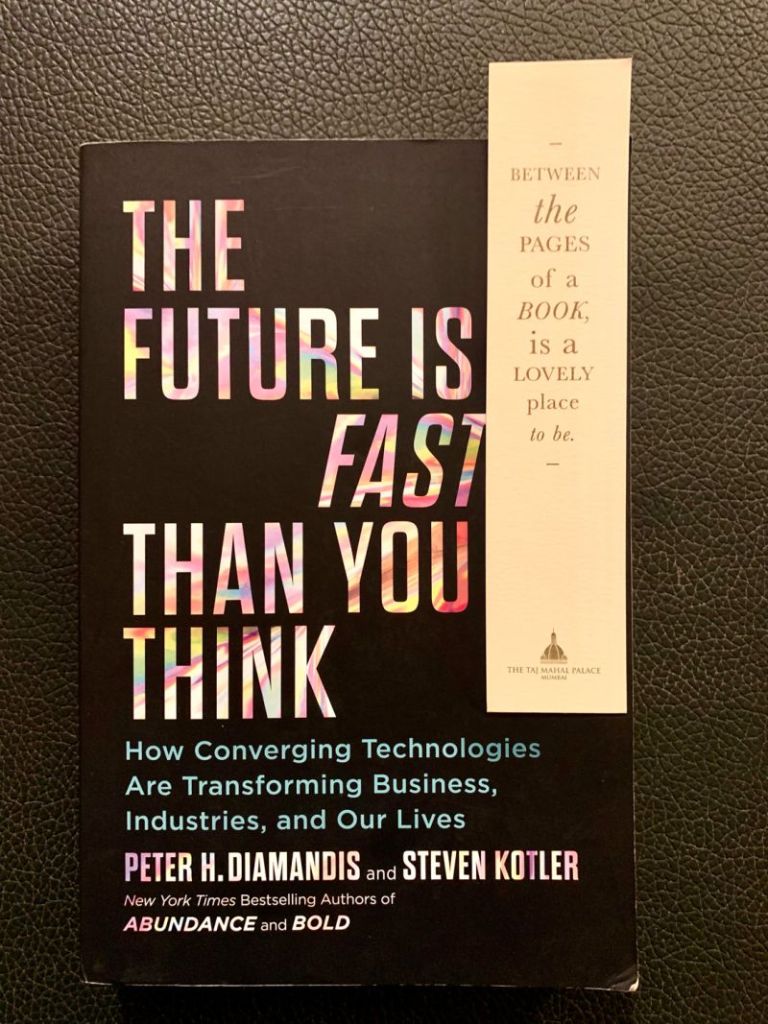
While staying at the Taj, a housekeeping staff member noticed my book on the bedside table. When I returned, I found a bookmark placed inside, carrying the words: “Between the pages of a book, is a lovely place to be.” Perhaps this was equally true for the Taj itself.
It is this thoughtfulness — beyond process, manuals, or the predictable script — that transforms a regular stay into a memorable one. The Taj demonstrates how a brand can be both value-driven and culturally empowered to act in ways that reflect care and attentiveness.
Lesson: In luxury, delight should never be an exception. The benchmark of excellence is reached when an organization sets high standards for itself, consistently puts the customer first, and empowers employees to act in alignment with those values.
Caption: Taj Hotels: where the smallest gestures become the benchmark of excellence. Alt Text: Taj Hotels case study symbolized by a book and bookmark gesture showing attentiveness.
IV. Pillar 3: Delight Beyond Luxury (The IndiGo Proof)
This final case study delivers the most actionable lesson: True delight is not the sole preserve of luxury brands. It is a universal discipline achievable in any business model.
Case Study: IndiGo – Operational Excellence with a Soul
IndiGo, celebrated for its operational efficiency and cost discipline, showed how even in a high-pressure environment, culturally empowered action can create a human connection:
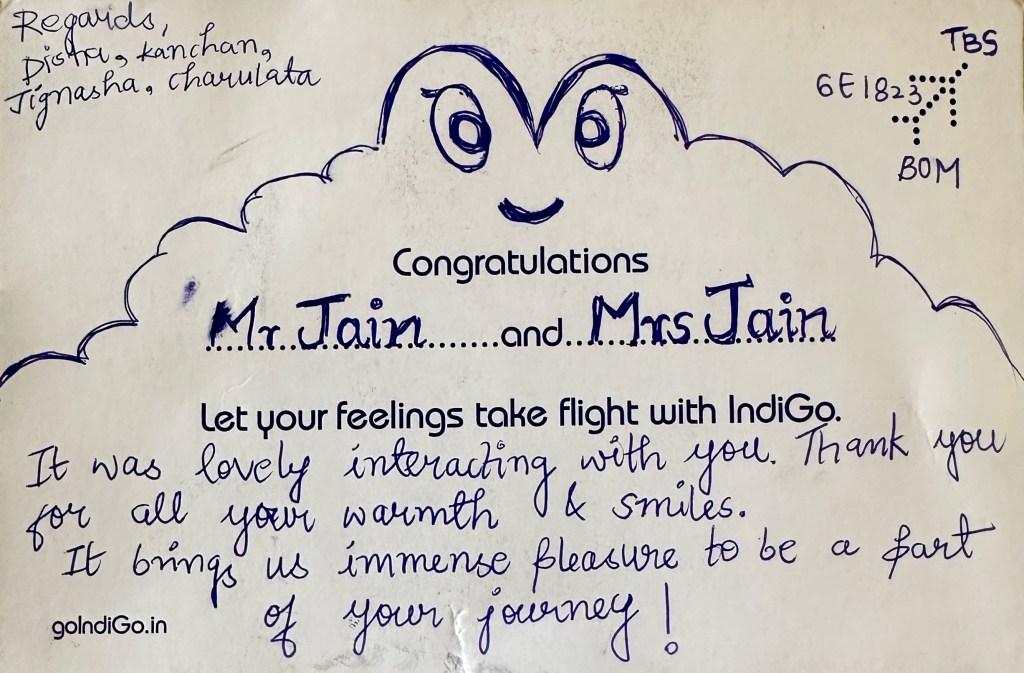
On a flight to Europe, I received a handwritten card from the crew.
On the return, a crew member (Uzma) personally accommodated a special meal request and followed up with a handwritten note.
They may sound small, but they reveal the truth of what builds lasting brands: in an industry defined by speed and precision, this crew paused to connect. They didn’t just deliver a service; they delivered an experience.
It reminded me of a story that has stayed with me: The sage Narada, who considered himself Lord Vishnu’s greatest devotee, once asked the Lord to name his greatest follower. Expecting to hear his own name, Narada was surprised when Vishnu pointed instead to a humble farmer. To show why, Vishnu asked Narada to balance a pot of oil on his head and circle the world. When Narada returned, Vishnu asked, “How many times did you think of me?” Narada replied, “None—my focus was entirely on the pot.”
The IndiGo staff fulfilled their duty (balancing the “pot of oil” of safety and process) while still finding space for genuine care. These mindful pauses proved that delight can emerge not in spite of efficiency, but because culture empowers individuals to act with empathy within the rigid process.
Lesson:True delight transcends category. It can be delivered as reliably in a value-for-money airline as in a luxury hotel when culture empowers staff to step outside the manual and choose connection.
Caption: IndiGo: operational excellence infused with a personal touch. Alt Text: IndiGo Airlines case study represented by handwritten note symbolizing human connection.
V. The Service Translation Framework: Scaling the Mindful Connection
The future of service requires leaders to not just manage the human gesture, but to design systems that scale its intent, leveraging AI and data to replicate the spirit of connection. for eg.
Service Element
Human Gesture (Today)
AI/Data Equivalent (Tomorrow)
The Touch
Handwritten note, bookmark
Hyper-personalized, proactive communication
Observation
Crew noticing a habit
AI predicting needs from behavior patterns
Proactivity
Off-script accommodation
Systems resolving issues before detection
Export to Sheets
Leadership Mandate: The goal is not about replacing the human touch, but scaling the intent of the human gestureacross every touchpoint.
VI. Conclusion: The Enduring Brand
The Service Translation Framework provides a clear structure for building enduring brand loyalty:
Air India highlights the risk of neglecting the Hygiene Factor.
Taj Hotels defines the benchmark of excellence in luxury.
IndiGo demonstrates the ultimate proof: Delight Beyond Luxury, showing that excellence is a discipline of culture and system, not a product of price point.
That balance—between the pot of oil and the mindful pause—is how enduring brands are built.
Related Reflection: If you’d like to explore this idea further, read my essay on Crafting Indian Luxury: Lessons for Brands and AI, which expands on how enduring brands balance heritage, human touch, and technological transformation.
About the Author : Vijay Jain is a seasoned consumer and retail expert with over 25 years’ experience in building and scaling businesses. As Founder-Director of ORRA and former CEO of ORRA and Ritu Kumar, he has led both founder-driven and professionally managed companies, delivering growth, cultural transformation, and customer-centricity. He brings a rare blend of financial acumen from investment banking and operating expertise as CEO. Today, as an Operating Partner, Advisory Board Member, and Board Mentor, he works across industries — from consumer and retail to wellness, food, and emerging tech — with a focus on governance, strategy, and sustainable growth. Deeply engaged with AI and digital transformation, Vijay helps businesses leverage technology, strategy, and people to scale faster and build future-ready organisations. He is also a recognized speaker, having shared insights on leadership, scaling brands, and digital transformation at platforms including CII, Harvard Business School, and Google.
This session of Startup Buzz, hosted by the Confederation of Indian Industry (CII) Western Region Startup featured Vijay Jain in conversation with entrepreneurs and leaders about the true dynamics of mentorship in the startup ecosystem.
Moderated by Pritam Onsker (Founder & CEO, Tailorsmart) with opening remarks by Ravikant Sabnavis (CII) in the presence of Ninad Karpe (Chair, CII Western Region Startup Subcommittee), the dialogue explored how founders and mentors can create relationships that accelerate growth without slipping into control or chaos.
🔑 Highlights from Vijay Jain’s talk
👉 My journey from investment banker → entrepreneur → CEO → mentor
👉 Why entrepreneurs live with ambiguity, while professionals optimize within frameworks
👉 The 5 pillars of effective mentorship:
Strategic clarity Opportunity scanning Prioritization Platform for scale And above all — Trust 👉 When mentorship accelerates growth — and when it risks becoming control or chaos 👉 How AI-driven tools can complement human mentorship
📺 Watch the full session here:
Event Host: CII Western Region
Speakers: Vijay Jain, with moderation by Pritam Onsker
Opening Remarks: Ninad Karpe, Ravikant Sabnavis, and the CII WR Startup Buzz team
About Vijay Jain
Vijay Jain, Founder-Director of ORRA and former CEO of ORRA and Ritu Kumar, is a seasoned consumer and retail leader with expertise across jewellery, fashion, and wellness. He now works as an Operating Partner, Advisory Board member, and Board Advisor, guiding businesses in brand building, omnichannel growth (retail + online), and consumer insights. His leadership has consistently delivered high growth and cultural transformation, earning him a reputation for building people-first, customer-centric organisations.
Vijay has also been invited to speak at leading conferences including CII, Harvard Business School, and Google, where he shares insights on leadership, scaling consumer brands, and digital transformation. Through his writing and talks, he is recognised for bringing management ideas to life by linking global strategy frameworks with the realities of Indian markets, positioning him as a thought leader at the intersection of business, technology, and leadership.
When I saw Vikram Chachraa’s post about his experience with a Waymo robotaxi in San Francisco, it reminded me of a question I asked myself a decade ago. At that point, I was deeply concerned about my chauffeur and the need for him to upskill. The question in my mind was never how, but when, would driverless cars come to India?
Well, unfortunately, when I left Mumbai for a year, he left too, and with him went more than just the three years’ advance salary. I often wish he had invested that money in upskilling instead. For the next five years (2020–2025), I was without a driver—an experience that made me appreciate, firsthand, both the joys and the frustrations of navigating India’s traffic.
While it may have taken longer than expected, it’s only a matter of time. The real question is: what would it take for driverless cars to succeed in India? This highlights a hidden, high-stakes battle of strategy that most people never see—a debate on how companies are building the future of technology.
I can’t help but think that Professor Henry Mintzberg would point to Waymo and Tesla as perfect illustrations of his theory on deliberate and emergent strategies.
The Deliberate and Structured Approach
On one side, we see the deliberate and structured approach. This is the Waymo strategy: a beautifully engineered system built for a controlled, predictable environment. Their vehicles are equipped with a complex and expensive suite of sensors, including multiple LiDAR, radar, and high-resolution cameras.
This is a very deliberate, structured approach to “seeing” the world. They must meticulously map every inch of a new area before launch, making scalability a cautious, step-by-step process. Every decision is data-driven and risk-averse, designed for low-risk execution within a carefully defined box.
The Emergent and Fluid Strategy
On the other side is the emergent and fluid strategy. My mind immediately goes to the chaotic, human-driven streets of India—and the approach of companies like Tesla. A system built for this environment cannot rely on perfection.
It must learn a new language of unplanned movements, non-verbal cues, and real-time adaptation. This strategy is about building from the ground up—a system that thrives on massive, diverse datasets and learns by doing. It embraces complexity and chaos as a necessary part of the learning process.
The Deeper “Why”
As users, we see the product—the self-driving car, the seamless app—but we don’t see the strategic choices behind their creation. Media frames it as “who is winning?” instead of “what are the long-term bets?” We see the “what,” but miss the deeper “why.”
The strategic challenge in complex, unpredictable markets like India isn’t about their ‘uniqueness,’ but their fundamental difference. A refined version of an existing product won’t work here; we must build an indigenous solution, trained on local data and designed for local realities. Even if the platform is global, it will need to be trained for India.
Which Strategy is More Likely to Succeed?
A system built for a controlled, deliberate environment will always struggle with the unpredictability of a market like India. An emergent system, by design, thrives in complexity—learning from chaos and adapting in real time. This gives it an advantage in environments like India, where unpredictability is the norm.
That said, some Indian cities may experiment with more deliberate approaches—creating geo-fenced zones or even carving out dedicated lanes for driverless cars. Such hybrid solutions could provide a bridge between deliberate precision and emergent adaptability.
But the question goes beyond cars. It raises a bigger point about leadership and strategy.
Leadership in a Deliberate vs. Emergent World
When hiring leaders—or when Boards are making these decisions—the question is often: which predominant skill set should take precedence, deliberate or emergent?
Deliberate = vision, long-term design.
Emergent = adaptability, resilience.
Both = empower innovation + alignment.
Adapting Strategy to Context
Do strategies need to shift depending on context? The answer is almost always yes.
Startups: Emergent strategy is vital. You need to iterate quickly, test hypotheses, and pivot until you find product–market fit. Yet even here, certain elements remain deliberate—for example, building a diamond-centric brand in a gold-dominated market requires intentional positioning and long-term brand storytelling.
Established players: Strategy becomes more deliberate, focused on scale, efficiency, and risk management.
Product lifecycle: Early stages demand emergence and discovery. As a product matures, the focus shifts to deliberate optimization—cost, scale, and stability.
What Strategies Do You Use?
These tensions between deliberate and emergent approaches are not limited to driverless cars or even to India. They show up in how we build businesses, lead teams, and make decisions every day.
What about you? In your own work, do you find yourself leaning more deliberate, more emergent, or a blend of both?
For a deeper look at how different mindsets shape decision-making — whether in founders, investors, or professionals — read Possibility. Probability. Execution. It explores how belief, analysis, and action coexist in leadership much like deliberate and emergent intelligence coexist in AI.
About the Author
Vijay Jain, Founder-Director of ORRA and former CEO of ORRA and Ritu Kumar, is a seasoned consumer and retail leader with expertise across jewellery, fashion, and wellness. He now works as an Operating Partner, Advisory Board member, and Board Advisor, guiding businesses in brand building, omnichannel growth (retail + online), and consumer insights. His leadership has consistently delivered high growth and cultural transformation, earning him a reputation for building people-first, customer-centric organisations.
Vijay has also been invited to speak at leading conferences including CII, Harvard Business School, and Google, where he shares insights on leadership, scaling consumer brands, and digital transformation. Through his writing and talks, he is recognised for bringing management ideas to life by linking global strategy frameworks with the realities of Indian markets, positioning him as a thought leader at the intersection of business, technology, and leadership.
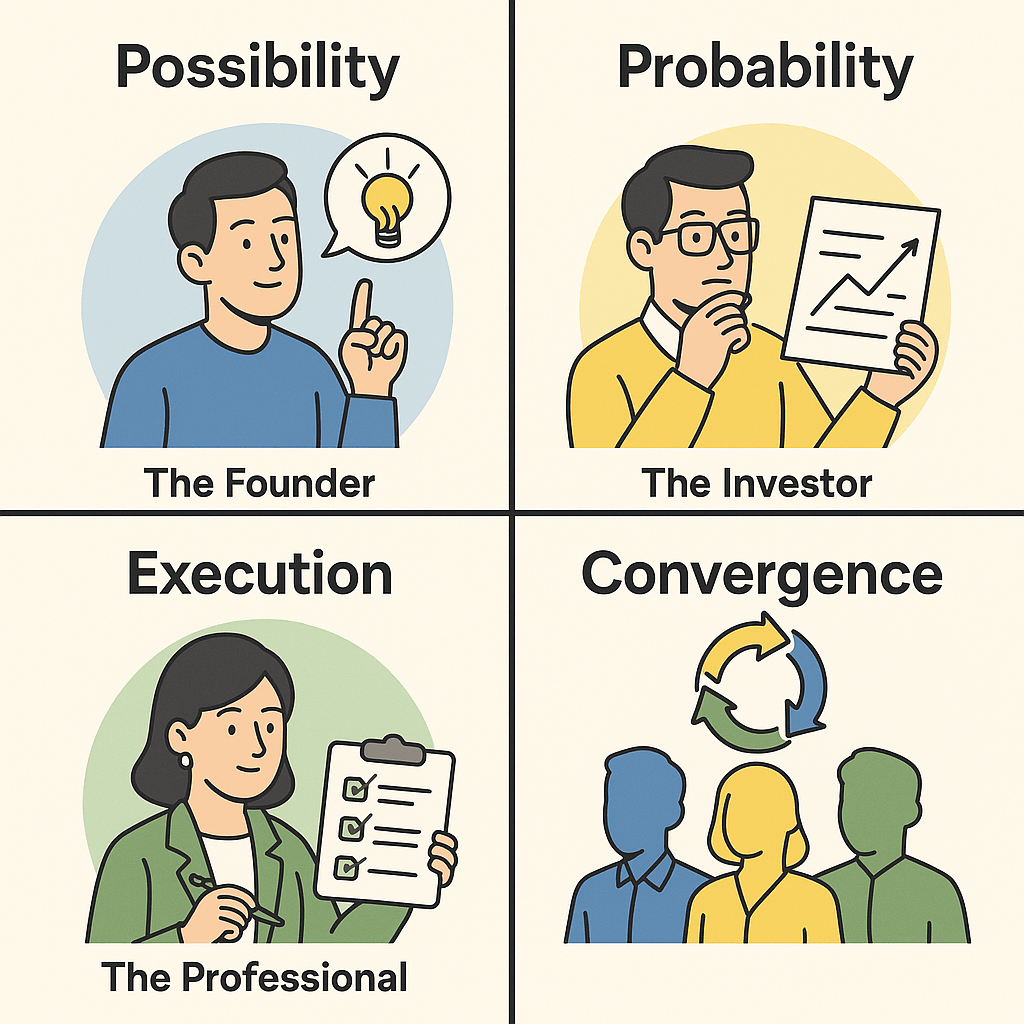
Having lived each of these roles — and worked with founders, teams and boards — I’ve come to realise:
It’s not just the work that’s different — it’s the mindset.
And the misalignment between these mindsets often creates friction — but also opens the door to real breakthroughs.
🔵 POSSIBILITY Founder Driven by conviction.
Sometimes even if no one believes — not the market, investors or customers
It’s a zero-one game. You succeed or you don’t — you have to be 100% committed.
There’s no Plan B.
At ORRA, we set out to build India’s first diamond-centric brand in a gold-led market — at a time when smaller diamonds were often considered “diamond dust.”
🟡 PROBABILITY Investor It’s not about building a portfolio or averaging returns.
It’s about making hard choices — selecting from hundreds of ideas, founders and markets — and even if you’re directionally convinced, figuring out which founder and opportunity to back.
Too often, funds are seen as playing a numbers game. To founders, it can feel like a lack of belief.
But from a fund’s side — they’ve seen this play out often and focus on helping companies scale.
For me, more than spreadsheets, conviction still comes first. Sometimes in the founder. Sometimes in the idea. Sometimes in the direction the world is tilting.
But most often, it’s the convergence of all three.
I’ve invested in companies like MediAssist, Slice and Zeno Health — and worked with VC/PE funds and their portfolio companies or founders.
It’s not just about exits but conviction — I invested in MediAssist in 2012 and still hold it post listing.
Each engagement began with belief — and support from partners, mentors and friends who made it possible.
So thank you.
🟢 EXECUTION Professional Execution turns belief into results.
Professionals seek clarity — but answers often lie in ambiguity and the ability to juggle, especially in early or high growth phases.
Adaptability and a growth mindset matter as much as expertise.
At Ritu Kumar, doubling EBITDA wasn’t just about vision.
It was about precision — and the ability to zoom out to allow flexibility.
🔱 CONVERGENCE Over time, I stopped seeing these as separate roles
Like the Trimurti: → Creation (Possibility) → Preservation (Probability) → Transformation (Execution)
Or the Japanese principle of Shuhari: → Shu (守) — follow → Ha (破) — break → Ri (離) — transcend
The real strength lies not in choosing one — but in recognising all three, and moving between them with intention.
At different stages, and in different moments, one may take precedence — but true leadership lies in the ability to hold all three as part of your mental model.
That awareness is what lets you shift gears seamlessly. Which one are you embracing right now?
Vijay Jain, Founder-Director of ORRA and former CEO of ORRA and Ritu Kumar, is a seasoned consumer and retail leader with expertise across jewellery, fashion, and wellness. He now works as an Operating Partner, Advisory Board member, and Board Advisor, guiding businesses in brand building, omnichannel growth (retail + online), and consumer insights. His leadership has consistently delivered high growth and cultural transformation, earning him a reputation for building people-first, customer-centric organisations.
Vijay has also been invited to speak at leading conferences including CII, Harvard Business School, and Google, where he shares insights on leadership, scaling consumer brands, and digital transformation.


 👉 Vijay Jain – Thoughts, Notes & Frameworks